
Affiliate disclosure: Tech Talk Pets may earn a commission when you purchase through links on our site, at no additional cost to you. This does not influence our research or recommendations. As an Amazon Associate, Tech Talk Pets earns from qualifying purchases. Learn more.
A smart pet door opens only for pets with an approved key, which might be a collar, a microchip or a tag. We compared five options using manufacturer specs, install guides and owner reviews to see how they differ on access method, size, app features and security.
This guide is based on manufacturer documentation, installation guides and owner reviews. We have not used these products ourselves; see How We Research Products. Checked October 2026.
Top Picks
- High Tech Pet Power Pet Smart Automatic Dog Door (Large)
Best for: Big dogs. A motorized, collar-activated panel that locks when closed, listed for pets up to 100 lb.
View at High Tech Pet - PetSafe SmartDoor Connected
Best for: App control with per-pet schedules and remote lock, in Medium and Large sizes.
View at Amazon - Pawport Smart Pet Door
Best for: Smart-home households. It mounts over most existing pet doors and lists Alexa, Google Home and Siri Shortcuts support.
View at Amazon
Comparison Table
| High Tech Pet Power Pet (Large) | PetSafe SmartDoor Connected | Pawport Smart Pet Door | SureFlap Microchip Pet Door Connect | Cat Mate Elite (microchip) | |
|---|---|---|---|---|---|
| Access key | Ultrasonic collar (MS-4 included) | Collar key; microchip (Medium only) | Pet tag | Microchip or RFID tag (entry only) | Microchip or ID disc |
| Pet size | Up to 100 lb (12¼ x 16 in opening) | Medium up to 25 lb; Large up to 100 lb | Medium up to 100 lb; Large 150 lb; XL 200 lb (new installs) | Large cats / small dogs (7.5 x 6-11/16 in flap) | Small to average cats |
| App / remote | No (on-door modes); Wi-Fi models sold separately | Yes, 2.4 GHz Wi-Fi | Yes; Alexa, Google Home, Siri Shortcuts | Yes, with Sure Petcare Hub | No (timer, LCD) |
| Power | AC; optional battery backup | 4 C-cell (Medium) or 4 D-cell (Large), or adapter | USB-C; built-in battery | 4 C-cell | 4 AA |
| Install | Door (wall and patio versions sold separately) | Door or wall; glass (Medium only) | Retrofits over most existing pet doors; indoor side only | Door, wall, glass | Door, wall, glass |
| Price tier | $$$ | $$ | $$$ | $$ | $ |
| Buy | Check price | Check price | Check price | Check price | Check price |
High Tech Pet Power Pet Smart Automatic Dog Door
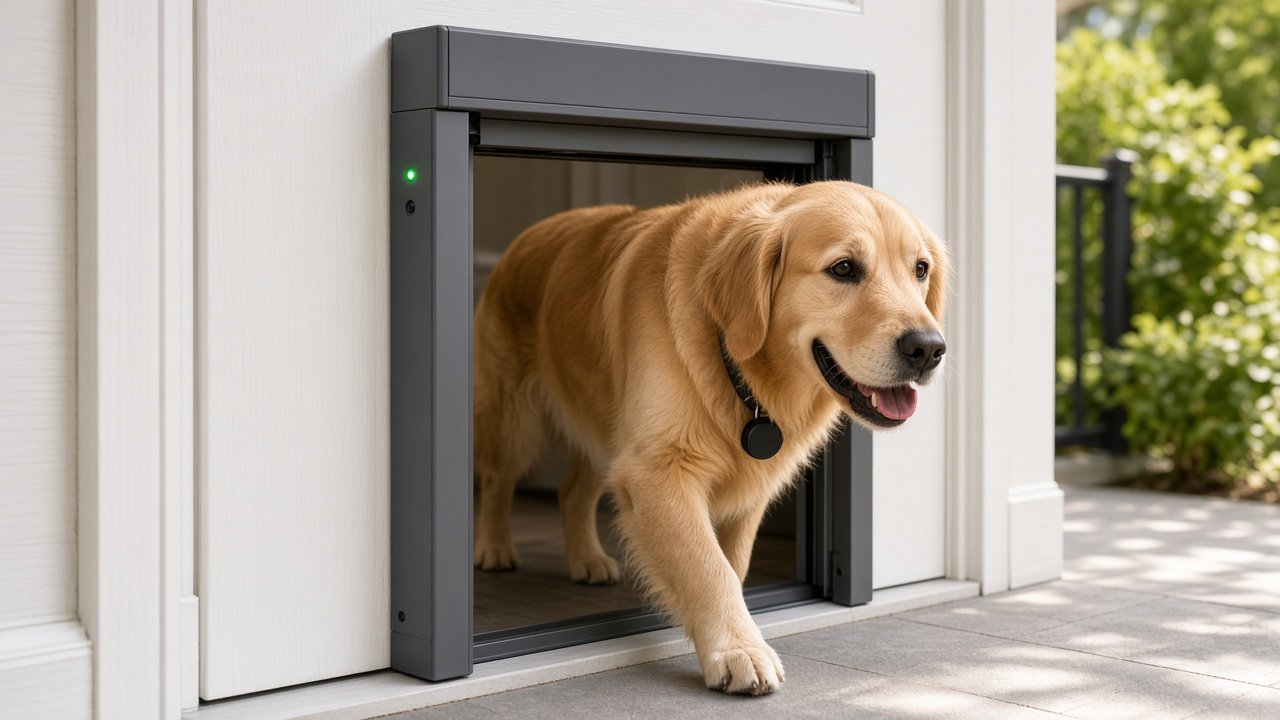
The Power Pet is a motorized door with a vertical panel that opens when a dog wearing the ultrasonic collar walks straight toward it. For the Large, Door Installation model (often referred to as the PX-2), High Tech Pet lists a 12¼ x 16 in opening for pets up to 100 lb, four access modes, separate inside and outside activation ranges, and automatic locking when closed. It ships with an MS-4 water-resistant collar (the waterproof MS-5 is a paid upgrade), runs on AC power with an optional battery backup, and pulls back automatically if something blocks the panel while closing. High Tech Pet also sells Medium, wall-mount, sliding-patio and Wi-Fi versions.
Short on vertical space? High Tech Pet’s Power Pet Roll Up door is a Wi-Fi-enabled, collar-activated door whose panel rolls up into the casing, so it can fit under windowsills or door windows. High Tech Pet says it opens in about one second, runs under 40 dB, includes an aluminum wall tunnel and a lockout panel, and works with the MS-5 and RX-10 collars.
Pros
- Motorized panel locks when closed
- Directional sensing, so the door doesn’t open when your dog just walks past
- Sized for big dogs, with patio, wall and Wi-Fi versions in the lineup
Cons
- The standard model has no app or remote monitoring
- Collar batteries need regular replacement (check High Tech Pet’s current estimate for your collar)
- Top price tier, and install is more involved
View at High Tech Pet View Roll Up at High Tech Pet
PetSafe SmartDoor Connected
PetSafe’s Wi-Fi door works with the My PetSafe app. You get per-pet schedules, remote lock and unlock, activity alerts and low-battery notifications. The Medium size (pets up to 25 lb) can pair with compatible microchips. The Large (up to 100 lb) uses SmartKey collar tags. It needs a 2.4 GHz Wi-Fi network. The Medium runs on 4 C-cell batteries and the Large on 4 D-cells, or either on an optional power adapter. PetSafe lists the Medium flap opening as 7.1 x 7.8 in and the Large as 11.9 x 16.1 in, and only the Medium supports glass installation.
Pros
- Full app control with per-pet access rules
- Activity log shows who went in and out
- Two sizes that cover most dogs
Cons
- Microchip pairing is Medium only
- 2.4 GHz only
- Battery and connectivity issues come up in some owner reviews
Pawport Smart Pet Door
Pawport is built to mount over most existing pet doors, so you may not need to cut a new opening. For new installs, Pawport offers a professionally installed Tunnel & Frame system. Its app covers remote open, close and lock, per-pet tags, schedules, activity tracking, lights, a weather lock and adjustable detection range, and Pawport’s FAQ lists Alexa, Google Home and Siri Shortcuts support. For new installs Pawport recommends up to 100 lb (Medium, 13.25 x 16.25 in opening), 150 lb (Large) or 200 lb (Extra Large); retrofit units fit existing openings up to 13.25 in wide.
Pawport says the Smart Pet Door itself is for indoor-side use only and is not waterproof, so it needs an existing flap, a Pawport outdoor door or a covered spot to keep rain out. Its battery is rated for 0–50°C (32–122°F).
Pros
- Retrofit design is easier for renters and existing pet-door owners
- Most smart-home friendly door in this guide
- USB-C powered
Cons
- Top price tier
- Not weatherproof on its own; needs a rain barrier
- Fit depends on the door you already have, so check Pawport’s sizing first
SureFlap Microchip Pet Door Connect
SureFlap reads your pet’s existing microchip (or an RFID tag). The Connect version adds remote lock and unlock, curfews and in/out alerts through the Sure Petcare app. It needs the Sure Petcare Hub (sold separately), which plugs into your router with Ethernet. Sure Petcare lists a 7.5 x 6-11/16 in flap opening, sized for large cats and small dogs, and up to 6 months on 4 C-cell batteries. Entry is selective only: the reader is on the outside, so any animal inside can exit.
Pros
- Uses your pet’s microchip, so there’s no collar to lose
- Can be installed in glass, walls or doors
- Good at keeping neighborhood cats out, based on owner reports
Cons
- Too small for most medium and large dogs
- The Hub is an extra purchase
- Reader controls entry only, not exit
Cat Mate Elite (microchip)
This is a budget microchip flap for cats that also accepts ID discs. It stores up to 9 cats, has a timer curfew and four-way locking, and runs on 4 AA batteries. It is sold in the US (model 355W) through retailers such as Amazon and Walmart; stock varies.
Pros
- Low price tier
- No app needed
- Curfew timer
Cons
- Cats and very small dogs only
- No remote control
Security Considerations
- A pet door is still an opening in your home. Lock modes and selective access keep animals out, but no manufacturer claim should be read as a guarantee against break-ins. Think about where you place the door and how large it is.
- Large doors mean large openings. Doors sized for 100 lb dogs can fit a small person. Use locking or curfew modes when you’re away or asleep.
- Keys can be lost or copied. Collar tags can fall off. Microchip-based doors avoid that risk.
- Know the power-failure behavior. Check each manual to see whether the door locks or stays unlocked when power or batteries run out.
- Protect your app account. For connected doors, use a strong password and two-factor authentication if it’s offered, and keep firmware updated. Our pet tech privacy and security guide covers what connected pet devices collect.
- Renters should check the lease. Get permission before cutting doors or walls. Retrofit and glass-insert options may help.
How to Choose
Measure your dog
Compare shoulder width and height with the flap opening, not the outer frame.
Pick your access key
Collar (Power Pet, PetSafe Large), microchip (SureFlap, Cat Mate, PetSafe Medium) or pet tag (Pawport).
Decide whether you need an app
Remote lock and activity logs help if you’re away from home a lot. Check Wi-Fi band requirements too.
Check where it can go
Door, wall, glass or sliding patio door. Each model supports different spots.
Factor in the extras
Hubs, collar batteries, tunnels, rain barriers and professional installation.
Frequently Asked Questions
How do microchip dog doors work?
A reader in the door scans your pet’s implanted microchip (or a tag) and unlocks only for registered IDs.
Can a smart dog door keep raccoons out?
Selective-access doors are designed to open only for registered pets, and owner reports are generally positive. Results vary, so use locking modes at night.
Do smart dog doors work with sliding glass doors?
Some do. High Tech Pet sells Power Pet patio inserts, and SureFlap, Cat Mate and the PetSafe Medium list glass installs. Check each brand’s installation options.
What happens if the power goes out?
It depends on the model. The Power Pet and Pawport offer battery options, and battery-powered doors (PetSafe, SureFlap, Cat Mate) keep working until the batteries run down. Check the manual for whether the door locks or stays open.
The Bottom Line
For big dogs, the High Tech Pet Power Pet is the most secure-feeling option here, with a motorized panel that locks when closed. If you want app control, the PetSafe SmartDoor Connected covers most dog sizes, and Pawport is the pick for smart-home households who already have a pet door. Cat and small-dog homes can look at SureFlap or the budget Cat Mate Elite. Whatever you choose, plan for locking modes at night.